
What to remember
- Court zones and specialist roles are different.
- A team rotates clockwise when it wins the right to serve.
- Ask which setting and substitution system the group uses.
Read the six court zones
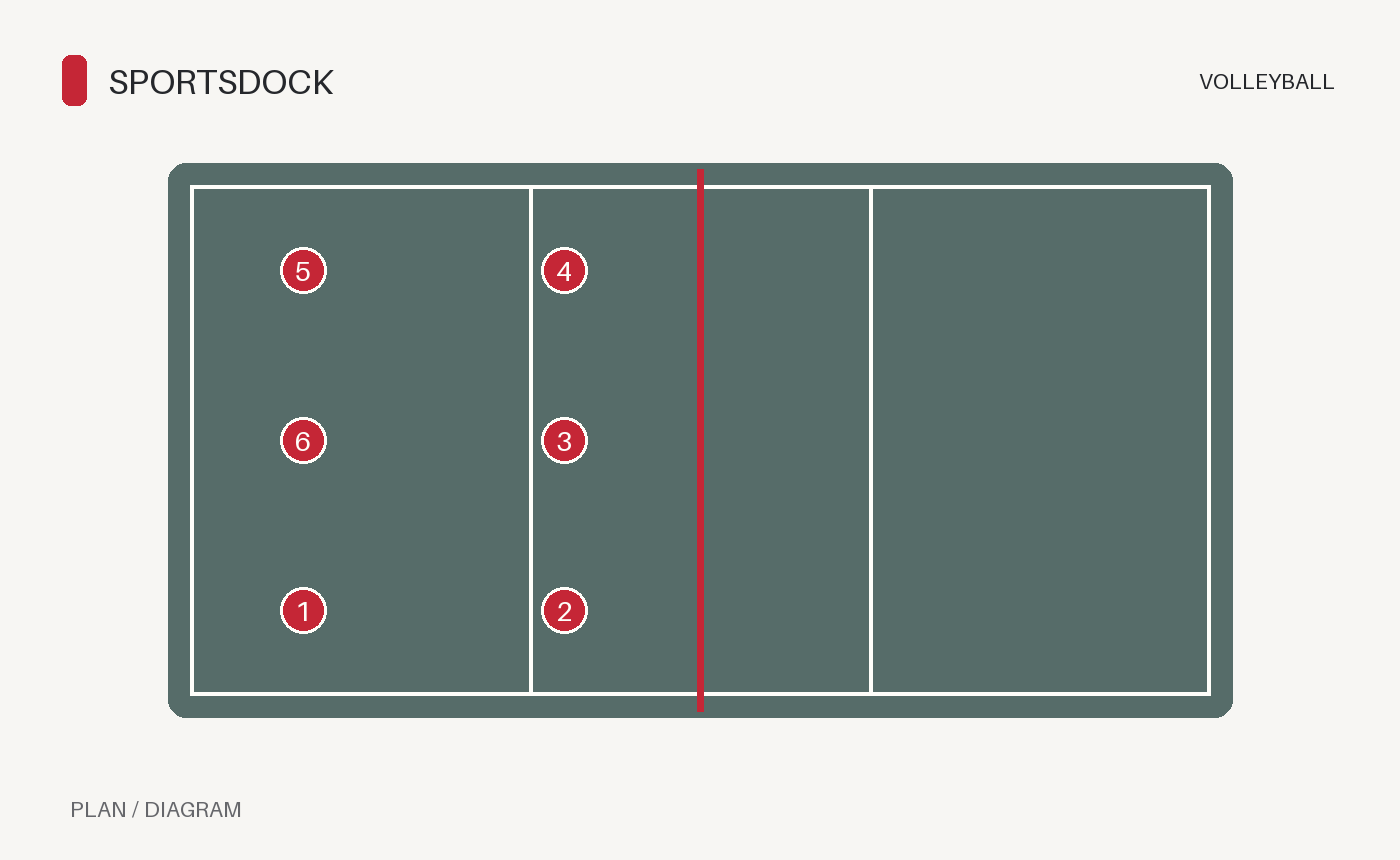
Facing the net, the front row runs from zone 4 on the left through 3 in the middle to 2 on the right. The back row is 5 on the left, 6 in the middle and 1 on the right. Zone 1 is the serving position.
Use those numbers to talk about starting locations, not to rank players. Stand on your own side and point to each zone before a rally. That small rehearsal helps when someone calls for a clockwise rotation.
Separate a role from a rotation spot
A setter usually organizes the second contact. Outside and opposite hitters attack from different sides, while middles contribute to central attacking and blocking. A libero is a specialist defensive role with restrictions defined by the rules.
Recreational teams may rotate the setting responsibility rather than use specialists. Do not assume a drop-in session uses a formal 5-1 system, libero replacements or fixed attacking assignments. Ask how this particular group organizes its six players.
Walk through one rotation
When a receiving team wins the right to serve, its players rotate clockwise. The player in zone 2 moves to 1 to serve. The rest follow 1 to 6, 6 to 5, 5 to 4, 4 to 3 and 3 to 2.
For example, if Maya starts in zone 2 and her team wins the opponent’s service rally, Maya moves to zone 1. She serves next. The rotation order and the player’s tactical role remain different concepts.
Clarify the receive arrangement
Before the serve, check the positional requirements in the applicable rules and the group’s chosen format. Front-row and back-row status matters even when players move to their playing positions after service.
Choose who covers a short serve, who calls a ball between two players and where the setter wants the first pass. Those agreements often help a recreational team more than memorizing an advanced formation it has not practised.
Choose a game that explains its system
Confirm six-a-side or another format, skill level, substitutions and whether everyone sets in turn. The official Volleyball Canada resources distinguish formal rules from a group’s own organization.
Look for volleyball games through SportsDock and ask the host about rotation before signing up. If you organize the session, explain the system in the game details rather than expecting newcomers to infer it.