
What to remember
- The five positions describe common jobs, not separate rulebooks.
- Agree on handling, spacing and defensive communication.
- In 3v3, responsibilities must be shared.
Recognize the five conventional positions
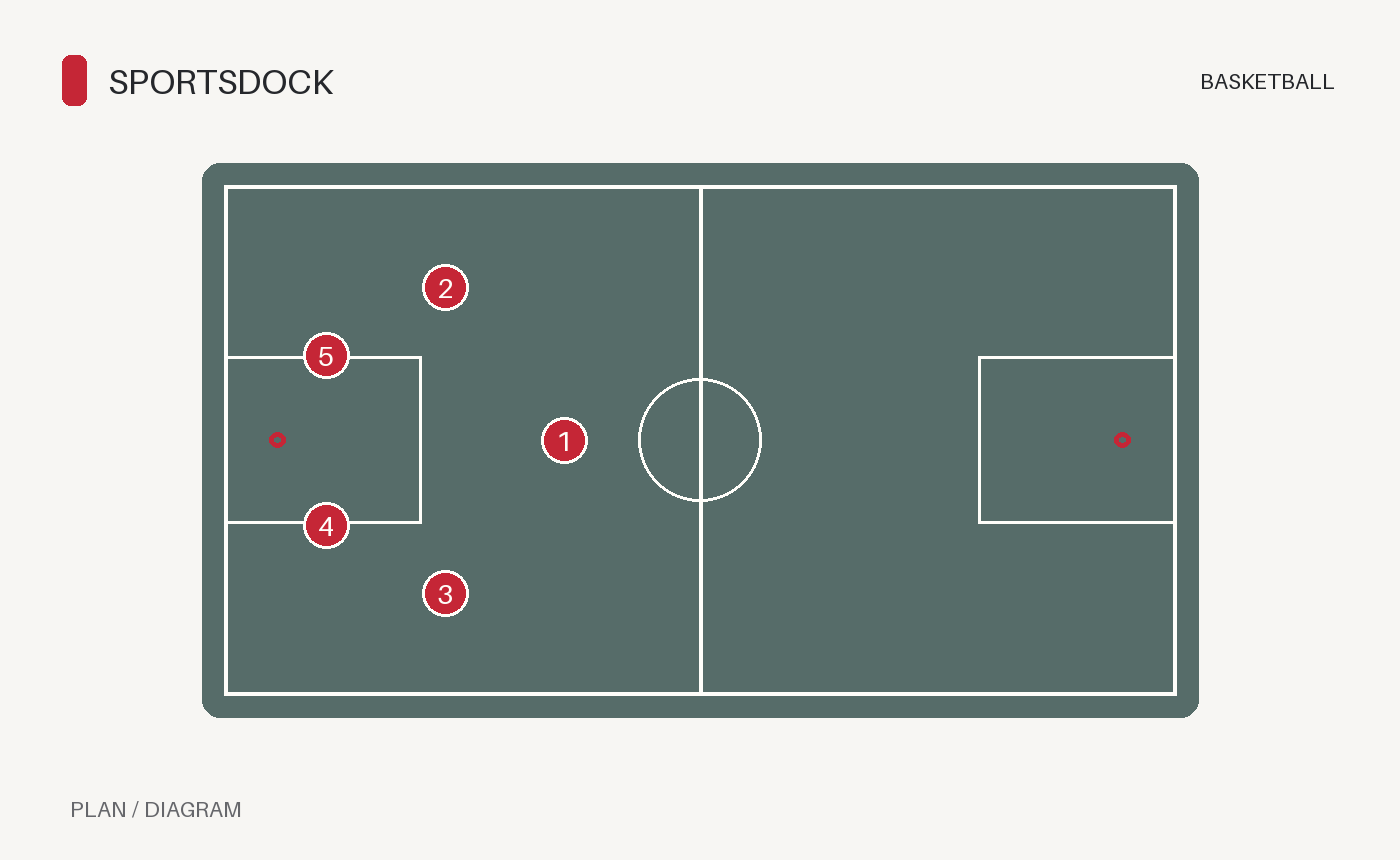
Point guard, shooting guard, small forward, power forward and centre are often numbered 1 through 5. They describe a common way of dividing responsibilities. They are not five different sets of playing rules.
A point guard often starts the offence. A shooting guard offers perimeter scoring and support handling. Wings connect perimeter and inside play. Bigger forwards and centres often contribute screening, rebounding and interior defence. Actual assignments depend on the players available.
Match the job to the group
Do not assign every tall player to the paint or every shorter player to handling the ball. Ask about experience, passing, shooting and defensive comfort. A player can bring the ball up on one possession and screen on the next.
Before the first run, identify a primary ball handler and decide who helps when that player is pressured. On defence, agree on matchups and how you communicate a screen. Those small choices prevent several players assuming somebody else has the same job.
Use a simple possession to understand spacing
Suppose one player drives from the right wing. A nearby teammate can move into a clear passing window instead of cutting across the driver’s path. Another can be ready to receive a pass outside the crowded lane.
This is an example of creating options, not a required offensive system. After passing, look at where your defender and teammates moved. Standing beside the ball makes it harder for the group to use the available court.
Share responsibilities in 3v3
Three players cannot reproduce five fixed roles. Each needs to pass, defend, rebound and recognize space. A useful agreement might identify who checks the ball, how screens are communicated and who returns to protect the basket.
Recreational half-court games may use local scoring and possession rules. Ask whether the group is following official 3x3 rules or its own format before assuming the shot clock, clearing rule or winning score.
Find a run with clear expectations
A role description should accompany an honest level assessment. Say what you are comfortable doing and ask how teams are selected or rotated.
Use the basketball pages on SportsDock to look for an appropriate run. If you create one, state the format and level. The group still needs to agree on roles together once the available players are known.